Six of Pentacles
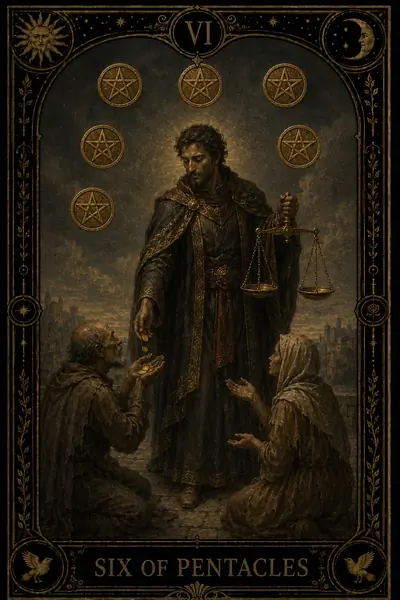
The Six of Pentacles shows a wealthy merchant weighing coins on a scale and dispensing them to a kneeling beggar, a scene of exchange where abundance meets need. Its archetype is resources set back into motion: what has been accumulated begins to circulate through generosity and fair distribution. Beneath the everyday image of almsgiving lies a deeper theme, the psychological balance between the role of giver and the role of receiver that each person occupies in turn.
Upright
The Six of Pentacles speaks of abundance set in motion, where what has been received begins to flow back into the world through generosity, support and fair exchange. On a psychological level it is a card of balance between giving and receiving, the open hand and the scales reminding that dignity lives in both roles. In relationships the energy shows itself as care, mutual support and gratitude that asks for no debt in return. In matters of work it marks a time of patronage, honest agreements and resources finding their way to those who truly need them.
In love
A relationship rests on mutual care and support, with one partner offering attention generously and the other able to receive it gratefully, free of any sense of debt.
Work & career
A patron, mentor, or colleague appears who is willing to share resources, expertise, or connections on fair and honest terms.
Money & finances
Finances stabilize through a fair exchange such as a repaid debt, a bonus, outside support, or a willingness to share income with someone in need.
Health & wellbeing
Recovery is aided by the support of professionals or loved ones, alongside a balance between caring for oneself and allowing that care to be received from others.
The card’s advice
An honest look at which role currently holds the balance, giver or receiver, helps guide action that matches the moment without pretense.
Reversed
Reversed, the Six of Pentacles exposes the shadow of unequal exchange, where generosity becomes a tool of power and help a means to bind and control. The scales tip here: one gives only for show or in expectation of gratitude, while another stays trapped in the role of the perpetually needy, losing all autonomy. In relationships it marks the imbalance between guardianship and dependence, debts wielded as leverage, gifts that carry a hidden price. In matters of work the card warns of false charity, of meanness masked as munificence, and of promised support that never quite arrives.
In love
Care turns into a lever of control, and the partner who continually receives loses independence, becoming dependent on another's generosity.
Work & career
Help offered at work comes with strings attached, expecting gratitude or compliance, and promised support from a superior or partner fails to materialize.
Money & finances
An unequal financial exchange looms, such as unpaid debts, favors with hidden conditions, or spending that creates dependency on another party.
Health & wellbeing
Excessive hovering by loved ones, or conversely a refusal to accept help, disrupts balance and slows recovery.
The card’s advice
Distinguishing sincere support from help that carries a hidden price matters, along with avoiding keeping others locked in the role of the perpetually needy.
Symbolism of the card
The scales held in the merchant's right hand symbolize justice, balance, and a measured, deliberate act of giving. They show that generosity is apportioned according to merit, not by chance.
The richly robed merchant in red embodies one who has wealth and the power to distribute it. His figure speaks of the patron-and-petitioner dynamic and of charity given from a position of power.
The merchant's hand drops coins into the beggar's palm, the card's central gesture, signifying the flow of resources from the haves to the have-nots. It is an act of mercy, aid, and exchange.
The beggar in yellow, kneeling with an outstretched hand, symbolizes vulnerability, need, and the acceptance of help. He reminds us that we may be either the giver or the receiver.
The second beggar in blue, also crouched at the merchant's feet, is not receiving coins in this moment, hinting at the selectivity of generosity and inequality in how bounty is shared.
The six pentacle coins floating along the card's edges denote material resources and the flow of earthly goods. They underscore the theme of shared abundance and the cycle of giving and receiving.
The card at a glance
Yes or no
Leans toward yes, provided the exchange is honest and balanced; the card grows cautious wherever the balance of power is too uneven.
Timing
Traditionally tied to the near term, a matter of weeks measured by the phases of the Moon, marking the moment resources are set into motion.
Astrology
The card is linked to the element of Earth and the sign of Taurus, along with the influence of the Moon, which governs the emotional rhythm of giving and receiving.
Combinations with other cards
Beside Cups cards it heightens the theme of emotional generosity and care, next to Swords it can point to formal or contractual assistance, and among other Pentacles it underscores the material side of exchange and questions of fairness in money.
Frequently asked questions
What does the Six of Pentacles mean in love?
It points to a balance of care and gratitude within a couple, where both partners are able to give and to receive support in turn.
What does the reversed Six of Pentacles mean?
Reversed, it signals an unequal exchange, generosity given with strings attached, dependency, or help used as a means of control.
Is the Six of Pentacles a yes or no card?
It leans toward yes when the exchange is fair; where power is clearly imbalanced the answer shifts toward a cautious it depends.
Does this card relate more to money or to relationships?
It applies equally to material matters and to relationships, since both rest on the same principle of fair exchange of resources and attention.