Five of Swords
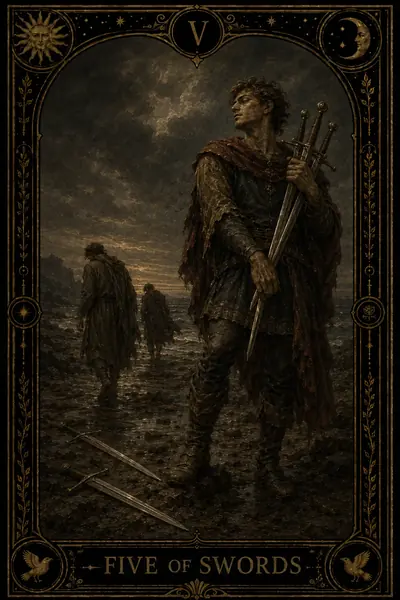
The Five of Swords shows a smirking figure gathering up abandoned blades while the defeated trail off toward the water beneath a jagged sky. The archetype at its center is a victory that cancels itself out the moment it is won, a goal reached at the price of trust and dignity. Beneath the image lies the psychology of pride and the compulsion to be right, even when it costs the relationship itself.
Upright
The Five of Swords speaks of a victory that leaves a bitter taste, a conflict whose triumph is won at the cost of dignity and connection. Psychologically it is the energy of pride, of the need to be right at any price, of a hollow conquest that rings empty once achieved. In relationships it surfaces as a quarrel of wounded egos, manipulation and power games standing in for intimacy. In matters of work it marks unfair rivalry, an argument won and respect lost, where the end did not justify the means.
In love
The card points to a quarrel where being right matters more than staying close, turning disagreement into a contest of wounded egos.
Work & career
At work it marks unfair rivalry or a conflict won on paper but costly in practice, as colleagues lose trust and reputation cracks.
Money & finances
Financial gain comes through questionable means or at someone else's expense, and such profit rarely brings real satisfaction.
Health & wellbeing
Constant tension and the need to prove superiority wear down the nervous system, showing up as irritability and disrupted sleep.
The card’s advice
It helps to ask what matters more, being right or preserving the relationship, and to end a dispute that benefits no one.
Reversed
Reversed, the Five of Swords reveals a weariness with hostility and a quiet wish to lay down arms. It is the shadow of festering resentment, of an inability to admit one's own share of blame, or conversely the moment of reconciliation and stepping out of the cycle of mutual wounding. In relationships it warns of old conflicts that corrode a bond, or hints at a tentative forgiveness. In matters of work it marks remorse after a needless fight, an effort to mend reputation and release a victory that was never worth its losses.
In love
A weariness with constant blame surfaces, along with a chance at reconciliation if both sides can own their share of the conflict.
Work & career
Workplace tension eases: an apology, a rebuilt reputation, or a clean break from a toxic environment becomes possible.
Money & finances
There is a reckoning with the cost of past financial battles, a readiness to release resentment over an unfair deal or a missed gain.
Health & wellbeing
Letting go of old anger relieves some psychosomatic strain, though buried resentment can still surface as hidden stress.
The card’s advice
Taking the first step toward truce, or honestly ending a bond held together only by mutual jabs, brings real relief.
Symbolism of the card
The smirking man in the green tunic gathers the others' swords — a symbol of a hollow, Pyrrhic victory won through deceit, humiliation and self-interest. His triumph is empty: he has won the battle but lost his honour and his allies.
The conqueror's contemptuous grin betrays gloating and a lack of compassion. This is the face of conflict where being right matters less than the urge to dominate and degrade the opponent.
Two swords on the shoulder and a third held point-down — the captured weapons of the defeated. The hoarded blades signify seizing others' power and winning at any cost.
Two dejected figures walk away toward the water, having dropped their arms — an image of defeat, shame and loss. They embody the cost of conflict: broken bonds and wounded pride.
Two swords abandoned on the ground signal surrender and the laying down of arms. They remind us that every conflict has a losing side, and weapons raised in anger end up in the dust.
The harsh, ragged clouds above the scene convey emotional turbulence, discord and the foul weather of conflict. The restless sky mirrors the hostile, unsettled atmosphere of the quarrel.
The card at a glance
Yes or no
Leaning toward no, since the card centers on conflict and loss rather than easy agreement.
Timing
Traditionally tied to the element of Air and to fast-moving, shifting events, with the conflict brewing and resolving within days or a few weeks.
Astrology
In the Golden Dawn system the Five of Swords corresponds to Venus in Aquarius, underscoring the cool rationality and detachment typical of an Air sign in matters of the heart.
Combinations with other cards
Beside conflict cards such as the Five of Wands or the Tower, it sharpens the theme of open confrontation; next to the Two of Cups or the Star it hints at reconciliation after the storm. Paired with the Three of Swords it deepens the emotional pain of the rupture.
Frequently asked questions
What does the Five of Swords mean in love?
It signals a quarrel where ego outweighs intimacy, warning that winning the argument may cost the relationship.
What does the Five of Swords mean reversed?
Reversed, it points to exhaustion with conflict and the chance of reconciliation or an honest end to a drawn-out dispute.
Is the Five of Swords a yes or no card?
It leans toward no, since it is fundamentally a warning card about conflict rather than a sign of harmony.
What does this card mean for work or career?
It warns of unfair competition or a dispute with colleagues in which a technical win costs lasting trust.