The Hierophant
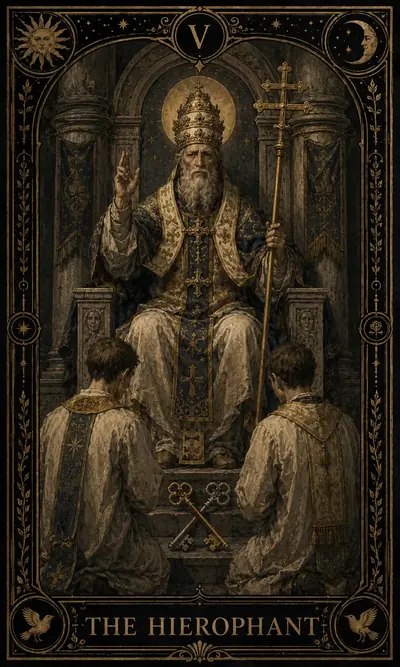
The Hierophant shows a high priest enthroned between two temple pillars, wearing a triple tiara and holding a triple cross, blessing two kneeling acolytes below. The archetype is that of the keeper of tradition and mediator between the sacred and the earthly, one who transmits knowledge through established ritual rather than personal revelation. The card's core idea is the strength of structure, continuity, and a moral authority trusted precisely because it has stood the test of time.
Upright
The Hierophant speaks of tradition, spiritual guidance, and the support of time-honoured foundations. It is the energy of the teacher and the bridge between the higher and the earthly: the card points to a search for meaning within established systems, to the value of ritual, discipline, and belonging to something larger. On a psychological level it is the voice of conscience and inner authority, the need to align one's actions with deep convictions. In relationships it speaks of commitment, loyalty, formal union, and shared values; in work, of mentorship, learning, and belonging to a structure that honours rules and continuity.
In love
The card points to relationships grounded in shared values, commitment, and a wish to formalize the bond - engagement, marriage, a wedding. Partnership here rests on respect for family tradition and stability rather than on passion or impulse.
Work & career
At work the Hierophant speaks of clearly hierarchical structures, mentorship, and teaching - the role of instructor, advisor, or student within an established system. Advancement comes through following rules, building a reputation, and gaining recognition from respected figures.
Money & finances
Financial behaviour leans toward conservative, tested strategies: saving, following advice from experienced professionals, avoiding risky ventures. Stability matters more than a fast return.
Health & wellbeing
Physical and mental condition improves through discipline, a steady routine, and reliance on conventional medicine or trusted specialists. Practices built on ritual and regularity are helpful, from sleep schedules to spiritual exercises.
The card’s advice
It is worth leaning on a mentor's experience, recognized methods, and inner convictions before acting alone. The value of the moment lies in aligning actions with a personal value system and in the readiness to learn from those who have already walked this path.
Reversed
In its shadow the Hierophant turns into dogmatism, blind adherence to rules, and the fear of straying from an imposed norm. It is a warning of frozen tradition that smothers living thought, of institutional hypocrisy and the pressure of others' expectations passed off as truth. On a psychological level it sounds the conflict between an inner voice and external authority, a rebellion against outworn beliefs or, conversely, a suffocating need for approval. In relationships it is formality without warmth, control, and outdated roles; in work, bureaucracy, rigidity, and resistance to change.
In love
The reversed card warns of a relationship frozen in formality: the bond persists out of habit, family pressure, or social expectation rather than genuine closeness. The opposite scenario is equally possible - open rebellion against rules imposed by a partner or family.
Work & career
At work this is bureaucracy, rigid leadership, and resistance to any change that does not fit an outdated regulation. The card can also reflect a break with an institution or profession that no longer matches personal convictions.
Money & finances
Financial decisions may be constrained by outdated rules, or conversely by blind trust in an authority without critically checking their advice. There is also the temptation to break accepted norms for quick gain.
Health & wellbeing
There may be a rejection of prescribed treatment and conventional medicine in favor of unproven methods, or, on the contrary, excessive dependence on others' instructions at the expense of one's own bodily experience. It matters to distinguish healthy skepticism from destructive stubbornness.
The card’s advice
It helps to ask honestly whose rules are actually being followed - deep personal convictions or norms imposed from outside. Rejecting dogma is justified when it rests on mature understanding rather than mere irritation at authority.
Symbolism of the card
The three-tiered papal tiara symbolizes dominion over three worlds and the union of body, mind and spirit. It marks the Hierophant as mediator between the earthly and divine orders.
The raised right hand, with two fingers up and two down, is the classic gesture of benediction linking the seen and the hidden. It conveys spiritual instruction and sanction from above.
The triple cross with three bars held in the left hand is the staff of the high priest, a sign of his office and authority to teach. Its three bars echo the triple crown and the three levels of initiation.
The two crossed keys at the Hierophant's feet are the keys of Saint Peter, unlocking the mysteries of heaven and earth, conscious and subconscious. They signify access to hidden knowledge through consecrated tradition.
The two tonsured figures below are disciples receiving the teaching, robed with roses and lilies (desire and purity). They embody the transmission of doctrine and the mediating role between humanity and the divine.
The two grey pillars frame the throne, marking the sacred space of the temple and the stability of organized religion. They set the boundaries of law, structure and tradition within which the Hierophant operates.
The card at a glance
Yes or no
Leans toward yes for matters requiring formal commitment and the backing of tradition; reversed, the answer shifts toward no or not yet due to rigid constraints.
Timing
Traditionally the card is linked to a slow, steady unfolding of events - weeks or months rather than a sudden turn. It is often associated with spring and with dates marked by rites or official ceremonies.
Astrology
The Hierophant is traditionally tied to the element of Earth and the sign of Taurus, and through it to the planet Venus, which governs values, stability, and the pursuit of a lasting way of life. This link underscores the theme of permanence and the material, bodily rootedness of tradition.
Combinations with other cards
Beside cards of union and partnership (The Lovers, Two of Cups) the Hierophant reinforces the theme of formalizing a relationship. Paired with cards of rebellion or upheaval (The Tower, The Fool) it shows the clash between established order and the pull toward freedom, while next to learning-themed cards it highlights the role of mentor or student.
Frequently asked questions
What does the Hierophant mean in love?
The card speaks of a relationship built on shared values and a wish for formal union - engagement or marriage - rather than fleeting passion.
What does the reversed Hierophant mean?
Reversed, the Hierophant points to dogmatism, formal relationships without warmth, or rebellion against imposed rules and expectations.
Is the Hierophant a yes or no card?
It leans toward yes in matters tied to tradition and formal commitment, but reversed it shifts toward no because of rigid constraints.
What do the crossed keys on the card symbolize?
The keys of Saint Peter at the Hierophant's feet represent access to hidden knowledge through consecrated tradition, joining the conscious and the subconscious.