The Hanged Man
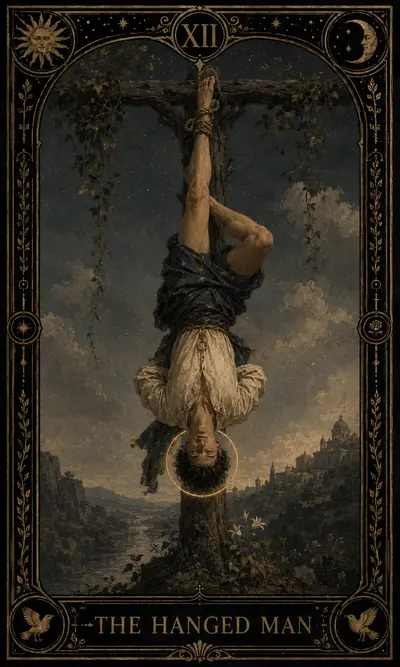
The Hanged Man shows a figure suspended upside down by one foot from a living Tau cross, his face calm and a golden halo glowing around his head. The card is the archetype of the willing pause, where the hero stops struggling not out of weakness but by conscious choice, in order to see the world from another angle. Its core is a paradox in which withholding action becomes the very source of insight and inner growth.
Upright
The Hanged Man speaks of a willing pause, a conscious suspension in which action gives way to contemplation. It is the card of the shifted perspective: the world turns over, and what looked like a dead end reveals itself as a chance to see the situation anew. On the psychological level it is the release of struggle and control in favor of inner insight, an acceptance of uncertainty as fertile ground. In relationships the energy appears as a season of stillness, tender surrender and the letting go of expectation. In matters of work it is the lull before change, when a solution ripens in stillness rather than in effort.
In love
A relationship passes through a season of stillness and gentle yielding, when listening to a partner matters more than pressing one's own point.
Work & career
A project stalls in visible inaction, yet it is precisely in that lull that a solution ripens, one that will later seem obvious.
Money & finances
Financial matters call for temporary restraint, since it is not the moment to take risks or force a deal but rather to observe from a distance.
Health & wellbeing
The body asks for slowing down and rest, and the suspended state teaches how to notice signs of fatigue before they become a real problem.
The card’s advice
It helps to stop pushing events forward and let the situation ripen on its own, trusting the pause as part of the process.
Reversed
In its shadowed form the Hanged Man speaks of a frozen pause, one that has slipped from conscious surrender into barren delay. It is suspension without meaning or fruit: sacrifice for its own sake, martyrdom, a clinging to the role of the one who suffers. The energy distorts into resistance to change, where the inner readiness to let go never arrives and the pause becomes a cage. In relationships it shows as passivity and hidden self-sacrifice that quietly breeds resentment, an unwillingness to move. In affairs it is stagnation, a stubborn waiting for rescue instead of releasing what has long since died.
In love
The pause curdles into prolonged silence and hidden resentment, as one partner performs self-sacrifice without ever receiving a response.
Work & career
Delay becomes chronic, decisions are postponed endlessly, and waiting for rescue replaces any real step forward.
Money & finances
Stubbornly clinging to a losing position or refusing to acknowledge a loss leads to stagnation instead of an honest course correction.
Health & wellbeing
Ignoring the need for rest turns into exhaustion, and the martyr's role makes it difficult to ask for help.
The card’s advice
It is time to stop holding onto the role of victim and take the first step, releasing what has long since lost its meaning.
Symbolism of the card
The crossbeam and trunk form a living Tau cross of growing wood, symbolising life, willing sacrifice, and the bond between heaven and earth.
The glowing golden halo around the inverted head marks enlightenment and spiritual illumination gained by surrendering the ordinary point of view.
The free leg is tucked behind the bound one, forming a figure-4 — a pose of willing suspension, poise, and a chosen stillness.
One ankle is bound to the beam, holding the figure upside down — he hangs by his own consent, not as a captive.
The red trousers represent the body, passion, and human desire — the earthly nature, momentarily subordinated to spirit.
The blue tunic signals knowledge, calm, and spiritual water — a mind holding serenity even in an inverted world.
The card at a glance
Yes or no
Leans toward "wait" - the card rarely gives a direct answer, showing that clarity arrives only after a pause and a shift in perspective.
Timing
Traditionally tied to periods of indefinite suspension, often linked to water and to months rather than a swift outcome.
Astrology
Corresponds to the element of Water and the planet Neptune, symbolizing the dissolving of ego, intuition, and the capacity to see what lies beyond ordinary logic.
Combinations with other cards
Beside action cards such as the Chariot or the Eight of Wands, the Hanged Man visibly slows their momentum, demanding a stop before anything moves. Paired with the Moon or the Hermit it deepens the theme of inner searching, while next to Death it underscores the need to release the old before a new stage can begin.
Frequently asked questions
What does the Hanged Man mean in love?
It points to a period of willing pause, tender sacrifice, and reassessment within a relationship, not to a breakup or the end of feeling.
What does the Hanged Man reversed mean?
Reversed, the card speaks of prolonged stagnation, fruitless sacrifice, and resistance to a change that is long overdue.
Is the Hanged Man a yes or no card?
The card leans toward "wait": a clear answer surfaces only after a pause, observation, and a change of viewpoint.
What does drawing the Hanged Man signal?
It signals the need to stop, release control, and look at the situation from an unfamiliar angle.