The Devil
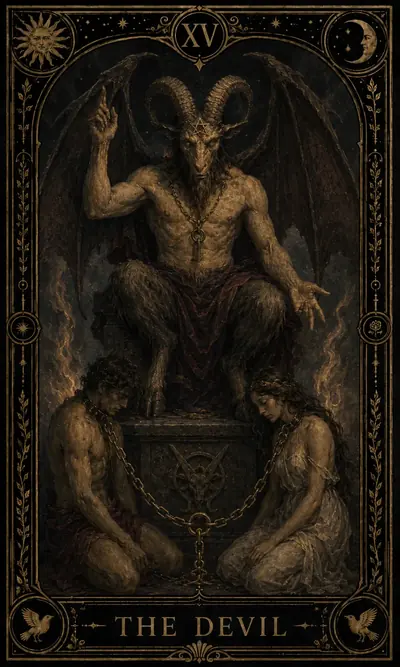
The Devil depicts Baphomet with goat horns and an inverted pentagram on the brow, presiding over a man and woman chained at the base of the pedestal. The card speaks of the dominion of the material and instinctual over the spirit, of dependency, compulsive desire, and the illusion that no other path exists. Yet the chains in the image hang loosely - the captivity is voluntary, and that detail carries the arcana's central psychological lesson.
Upright
The card speaks of the dominion of the material and instinctual over the spirit - of chains that hang loosely and bind only because they are permitted to. Its energy is one of dependency, compulsive desire, raw passion and the illusion that no other road exists; within that shadow also lies an honest meeting with the rejected, darker self. In relationships it appears as an attraction where passion entwines with possessiveness and mutual unfreedom. In matters of work it is the lure of easy gain, growth traded against conscience, and the danger of being shackled by what once promised liberty.
In love
Relationships carry an intense attraction in which passion is entwined with possessiveness and mutual unfreedom. What holds partners together may be habit, jealousy, or fear of being alone rather than genuine affection.
Work & career
The lure of easy gain comes to the foreground, with advancement traded against conscience. Work can become so consuming that it turns into a dependency rather than a source of fulfillment.
Money & finances
Material interest overrides sound judgment: impulsive spending, debt, or deals that look attractive but conceal a trap become likely. Financial gain is achieved, but at the cost of inner freedom.
Health & wellbeing
The card often points to dependencies - on food, stimulants, or habits - and to bodily symptoms rooted in suppressed tension. The body signals that instinct has overridden restraint.
The card’s advice
Naming honestly whatever holds one captive, rather than excusing it as necessity or fate, matters more than any grand gesture. Recognizing one's own part in the dependency is the first step toward loosening the chains.
Reversed
Here the card's energy speaks of chains coming undone - of the moment when the grip of compulsive desire loosens and the illusion of dependency is seen clear through. It is a painful yet freeing sobriety: the recognition of one's own part in what held captive, and a refusal to keep feeding fear and shame. In relationships it marks the exit from a co-dependent or suffocating bond, or conversely a stubborn clinging to what is destructive against all evidence. In work it brings a break from poisoning compromises, yet also the risk of self-deception, where freedom is merely declared while the old fetters quietly remain.
In love
The reversed Devil shows an exit from a co-dependent or suffocating bond, a break from a toxic attraction. The opposite scenario is also possible - a stubborn clinging to a destructive relationship against every obvious sign.
Work & career
A break comes from compromises that had been poisoning the work - leaving a toxic environment, refusing a dishonest deal, returning to work done with a clear conscience. There is a risk, though, that freedom is only declared while the old patterns quietly persist.
Money & finances
A chance appears to break free from debt or destructive financial habits. It matters to distinguish genuine recovery of the budget from an illusion of control behind which the old temptations remain.
Health & wellbeing
In reverse the card points to the start of recovery - giving up a harmful habit, admitting the problem, seeking help. It is a painful yet freeing process of sobering up.
The card’s advice
It is worth verifying that the liberation is real rather than a declaration unaccompanied by any change in behavior. Honest work with fear and shame, instead of suppressing them, is what truly unlocks the chains.
Symbolism of the card
The reversed five-pointed star on the Devil's brow signifies matter ruling over spirit: its single point aims downward, and the animal nature triumphs over reason.
The open palm with fingers splayed upward is a blasphemous parody of the gesture of benediction, promising false liberation while in truth sealing the bonds.
The goat's horns, ass's ears and fixed stare of Baphomet embody blind appetite, ignorance and bondage to bodily passions.
The burning torch held with its flame pointing down symbolizes the destructive, base misuse of fire and creative energy, leading to self-ruin.
The chains resting loosely on the captives' necks and fixed to the ring of the pedestal show the bondage is voluntary: the fetters are loose enough to slip off.
The female figure's tail ends in a cluster of grapes, marking sensual pleasure, intoxication and carnal desire that bind her to the Devil.
The card at a glance
Yes or no
Leaning toward no: the card points to dependency, compromise, and hidden constraints that tend to work against a free and healthy outcome.
Timing
Traditionally tied to a long, heavily dragging period or to a situation that feels endless precisely because of inner resistance to change; release comes not on schedule but at the moment of awareness.
Astrology
The arcana corresponds to the sign of Capricorn and the planet Saturn, symbolizing structure, restriction, and material discipline that, when distorted, becomes a prison of one's own instincts.
Combinations with other cards
Beside the Lovers or the Two of Cups, the Devil sharpens the possessive, dependent side of attraction; next to the Tower it foretells a sudden and painful breaking of the chains. Near Pentacles cards, the emphasis shifts toward material traps and financial bondage.
Frequently asked questions
What does the Devil card mean in love
It points to an intense but possessive attraction in which partners are held together as much by habit or fear of loneliness as by genuine feeling.
What does the reversed Devil card mean
Reversed, it signals liberation from a dependency or toxic bond, though at times it shows a stubborn clinging to something destructive instead.
Is the Devil a yes or no card
It leans toward no, since it represents dependency and hidden constraints that tend to block a free and healthy resolution.
What do the chains on the Devil card symbolize
The chains resting on the figures' necks are loosely fastened, showing that the captivity is voluntary and could be shed at any moment.