Death
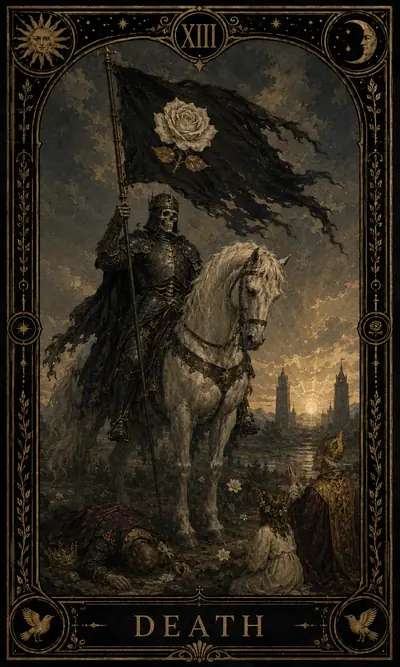
Death is the thirteenth trump of the tarot, showing a skeletal knight in black armor riding a pale horse past a fallen king, a pleading bishop, and a kneeling child. The card is not about literal dying but about the inescapable law of transformation: an outworn form of life collapses to make room for a new cycle. In Jungian terms it depicts the death of an old ego-identity so that a more authentic self can emerge.
Upright
This card speaks of inevitable endings and profound transformation: what has run its course falls away, clearing the ground for a new cycle of life. On the psychological level it marks the death of an old identity, the shedding of illusions and masks in favour of genuine renewal. In relationships its energy appears as a rupture after which a bond is either reborn on different terms or honestly brought to a close. In matters of work it signals the end of an outworn phase, a clearing away of the surplus and an unstoppable passage into a new order of things.
In love
A relationship passes through a sharp turning point: the bond is either rebuilt on more honest terms or the separation becomes unmistakable and final. For those who are single, the card marks the close of a prolonged period of solitude and an opening toward a genuinely different chapter.
Work & career
A prior working phase comes to an end — a position, project, or professional role has run its course and gives way to the next stage. Layoffs, restructuring, or a voluntary departure from what no longer holds meaning are typical expressions.
Money & finances
Finances go through a clearing-out: old debts are settled, unprofitable ventures are closed, and space opens for a new source of income. Sharp expenses in this period usually signal necessary renewal rather than loss.
Health & wellbeing
The card points to the end of a draining condition or lifestyle and the start of a recovery phase. It often reflects a decision to give up a harmful habit or to pass through a significant health crisis toward genuine healing.
The card’s advice
It helps to stop holding on to what has objectively already ended and to trust the logic of the cycle: letting go of the old opens space for the new. Resisting an inevitable transition only prolongs the difficulty.
Reversed
In its shadow aspect the card points to resistance to change and the fear of releasing what has outlived itself: there is a clinging to what is already dead and a stalling within a prolonged in-between. The distortion shows itself as stagnation, the repetition of old scripts and an inner decay where renewal was required. In relationships it appears as the painful prolonging of a bond drained of meaning, a refusal to admit its ending. In work it manifests as inertia, a dread of closure and the missed moment of a necessary transition.
In love
Partners keep a bond alive that has already dissolved on the inside, out of fear of emptiness or change. The relationship feels stuck in place, replaying the same unresolved conflict.
Work & career
There is a clinging to a role or position that has long outlived its purpose, driven by fear of losing stability. This breeds stagnation, missed opportunities, and a slow burnout in a place that should have been left behind.
Money & finances
Financial trouble drags on because the old model of earning or spending is not acknowledged as broken. Delaying necessary decisions — a sale, a debt restructuring, a change of income source — deepens the problem.
Health & wellbeing
In reverse the card describes a chronic condition sustained by refusing to change habits or seek help. The body signals a need for change that is being consciously postponed.
The card’s advice
It is useful to name honestly what has already ended rather than keep simulating its continuation. Acknowledging an ending is not defeat but the first step toward freeing energy for what comes next.
Symbolism of the card
Death itself rides as a skeletal knight in black armor — impersonal and inexorable. It is not cruel but simply enacts the unavoidable law of transformation that spares no one.
The black banner bears a white mystic rose — a symbol of purity, immortality and the renewal of life. Amid the darkness of death blooms the promise of rebirth.
The pale horse advances calmly and unstoppably, treading over all in its path. Its whiteness signifies the purity of change itself, free of fear.
A fallen king lies beneath the horse's hooves — before death, power, crown and rank are powerless. No status grants exemption from the law of change.
An innocent child meets Death without fear, kneeling in acceptance. A pure spirit can face the inevitable transformation with calm.
A bishop in his mitre stands with folded hands, pleading before Death — the one figure who faces it directly. Spiritual wisdom teaches one to entreat and accept rather than flee.
Between two towers on the horizon the sun rises — an image of immortality and eternal renewal. Every ending is followed by a new dawn.
The card at a glance
Yes or no
Leaning toward no when the question concerns preserving the current state of affairs, since the card signals ending rather than continuation. As a symbol of transition it favors a decision to start over rather than an attempt to preserve the old.
Timing
Traditionally linked to autumn and to seasonal turning points, when nature sheds the old before winter rest. In terms of speed the card indicates not an instant event but an irreversible change that unfolds over several weeks.
Astrology
The card corresponds to the sign Scorpio and its ruling planet Pluto, both associated with deep transformation, destruction, and rebirth through crisis. This link underscores death as a psychological process rather than a literal end.
Combinations with other cards
Next to the Tower or the Wheel of Fortune, Death intensifies the theme of a sudden, unavoidable turn of fate. Paired with the Star or the Sun it softens, showing that hope and renewal follow the ending rather than emptiness. Near cards of Swords the emphasis shifts to the mental recognition that change is necessary.
Frequently asked questions
What does the Death card mean in love?
It signals a turning point in a relationship — either an honest ending or a deep rebuilding of the bond on new terms. The previous dynamic of the couple ceases to exist in one way or another.
What does the reversed Death card mean?
Reversed, the card points to resistance to change and clinging to what has already lost meaning. It describes being stuck in a transition out of fear of letting go of the past.
Is Death a yes or no card?
It leans toward no with regard to keeping things as they are, since its essence is ending rather than continuation. It favors starting something new over holding on to the old.
Does the Death card mean literal death?
No, in the overwhelming majority of readings the card symbolizes psychological transformation and the close of a life phase rather than physical death. This is one of the most persistent myths about tarot and is not supported by the card's traditional meaning.