Eight of Cups
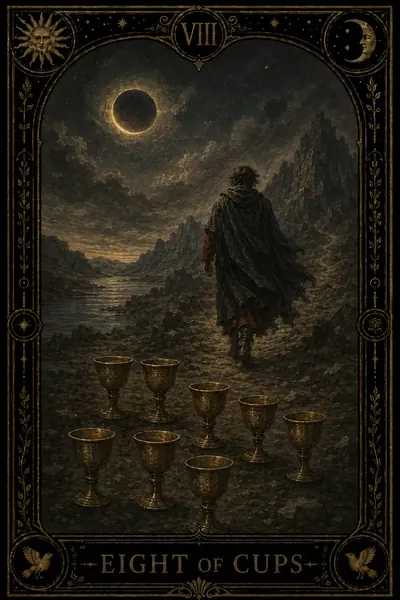
The Eight of Cups portrays the archetype of the pilgrim who turns away from a life that looks complete on the surface yet feels hollow within. A cloaked figure leaves eight neatly stacked cups behind and walks toward distant mountains beneath a watching double moon, abandoning not scarcity but exhausted meaning. It is a card of ripening rather than loss, where the pull to move on arises precisely where everything seems already achieved.
Upright
The Eight of Cups speaks of a quiet yet resolute departure: a figure leaves behind eight filled cups and walks away toward the mountains beneath a cool, watching moon. It is an image of inner ripening, when outward abundance no longer nourishes the soul and a hunger for deeper meaning takes hold. On the psychological level the card mirrors honesty with oneself and the courage to name emptiness for what it is. In relationships it is the energy of conscious endings and the search for true closeness; in matters of work, the willingness to release what is exhausted for a calling that still waits beyond the horizon.
In love
Points to an honest acknowledgment that a relationship no longer nourishes the soul, even if it appears stable from the outside; a conscious separation or a period of solitude to reconsider intimacy is likely.
Work & career
Suggests leaving a position or project that no longer matches inner values in favor of work that feels like a true calling.
Money & finances
Financial stability takes a back seat to the need for deeper meaning, and a voluntary trade-off of income for a more significant path is possible.
Health & wellbeing
Reflects fatigue built up from long neglect of one's own needs, and the benefit of a deliberate pause, a change of environment, or spiritual practice.
The card’s advice
Trusting the inner call away from what has been exhausted tends to serve better than staying for appearances, even when the choice looks impractical from outside.
Reversed
Reversed, the Eight of Cups exposes the shadow of an unfinished departure: a lingering in place, a fear of leaving the familiar even when it has long since run dry. Here the energy stalls between the wish to go and the dread of solitude, breeding endless wavering and a muted sorrow. It can appear as aimless flight - one change after another, anything to avoid meeting oneself - or, conversely, as clinging to spent bonds and ventures out of guilt. The card warns of the illusion that a new place will heal on its own, while the root of the dissatisfaction remains within.
In love
Points to remaining in a relationship that has long stopped bringing joy, out of fear of solitude or a sense of duty, or to fleeing a bond without examining the real reasons.
Work & career
Suggests hesitation before resigning or changing course, a circling between the wish to leave and clinging to a familiar position.
Money & finances
Reflects postponing needed change out of anxiety over financial stability, which only prolongs inner dissatisfaction.
Health & wellbeing
Warns of chronic exhaustion that builds when the need for change is suppressed, and of the risk of fleeing into new circumstances without doing the inner work.
The card’s advice
It helps to distinguish what is truly holding things in place from the illusion that a new setting alone will resolve the matter without inner change.
Symbolism of the card
The cloaked figure in red turns its back and walks away from the assembled cups. It embodies conscious renunciation: a voluntary departure from what has been built in search of a deeper meaning.
The double moon bearing a human face gazes down, fusing sun and moon in one body. It signifies the soul's night journey, the turning of cycles, and the intuition that guides the wanderer through darkness.
Eight golden cups are neatly stacked, yet a gap breaks the upper row. This missing place reveals that the emotional structure is incomplete, and it is that very imperfection which drives the hero to leave.
The traveller leans on a long staff, bracing for a hard climb. The staff marks pilgrimage and the resolve to traverse the rugged path of personal seeking.
Bright red boots already step into the waters of feeling, taking the first stride away. Their red betrays the passionate, willful energy that powers this leave-taking.
Dark mountain ridges rise along the hero's route, marking the hardships ahead. They symbolise the spiritual ascent and the unknown heights toward which the soul presses on.
The card at a glance
Yes or no
Leans toward no: the card speaks of pause, withdrawal, and reassessment rather than a swift affirmative step forward.
Timing
Traditionally linked to the autumn-winter turn and to processes that unfold slowly over several months, since the decision to leave tends to ripen gradually.
Astrology
Corresponds to Saturn in Pisces: the discipline and structure of Saturn meet the watery intuition of Pisces, framing a mature, deliberate renunciation of the old in favor of spiritual growth.
Combinations with other cards
Beside cards of ending (Death, Ten of Swords) it intensifies the theme of a decisive break; near the Hermit or the Star it underscores the spiritual nature of the search, while proximity to the Five or Nine of Cups signals that the departure is rooted in emotional dissatisfaction rather than outer circumstance.
Frequently asked questions
What does the Eight of Cups mean in love?
It usually points to a conscious ending of a relationship that has stopped providing emotional fulfillment, or to a period of solitude spent reconsidering intimacy.
Is the Eight of Cups a yes or no card?
It leans toward no, since it describes withdrawal and pause rather than a direct move toward a goal.
What do the eight cups in the image symbolize?
The neatly stacked cups with a gap in the top row symbolize a life that looks outwardly complete yet remains inwardly unfinished, prompting change.
How does the reversed meaning differ from the upright one?
Upright, the card shows a timely and conscious departure, while reversed it shows stagnation, fear of change, or flight without understanding the underlying cause.